Great cooking has never been about time. It's about knowing the exact moment something is ready, and no clock can tell you that.
Ask any real cook how they know a steak is done, and they won't mention minutes. They'll talk about the color of the sear, the firmness under a spatula, the sound the pan is making, the way the fat renders. Cooking is a perception problem wearing a timer's clothing. Every recipe that says "cook for 8 minutes" is quietly lying to you, because 8 minutes on your stove, with your pan, with a steak of your thickness, is a different dinner every single time.
This is the problem most kitchen robots refuse to solve. They inherit the timer, automate it, and call it cooking. The result is a machine that fails the same way a distracted person does: undercooked, overcooked, or lucky. We think that's the wrong foundation. So we're building Cheffy to cook the way a person actually does, by watching, listening, feeling, and adjusting until the food is right.
The perception problem
A stove is a hostile place to be certain about anything. The heat isn't consistent, a burner set to "medium" on one range runs hotter than "high" on another, and a stove that's a little worn heats differently on Tuesday than it did last month. The ingredient isn't consistent either, no two cuts of chicken share a thickness, no two onions the same water content. Cooking well means holding all of that uncertainty in your head at once and reacting to it in real time. A fixed recipe can't. A cook can. That gap is the entire opportunity.
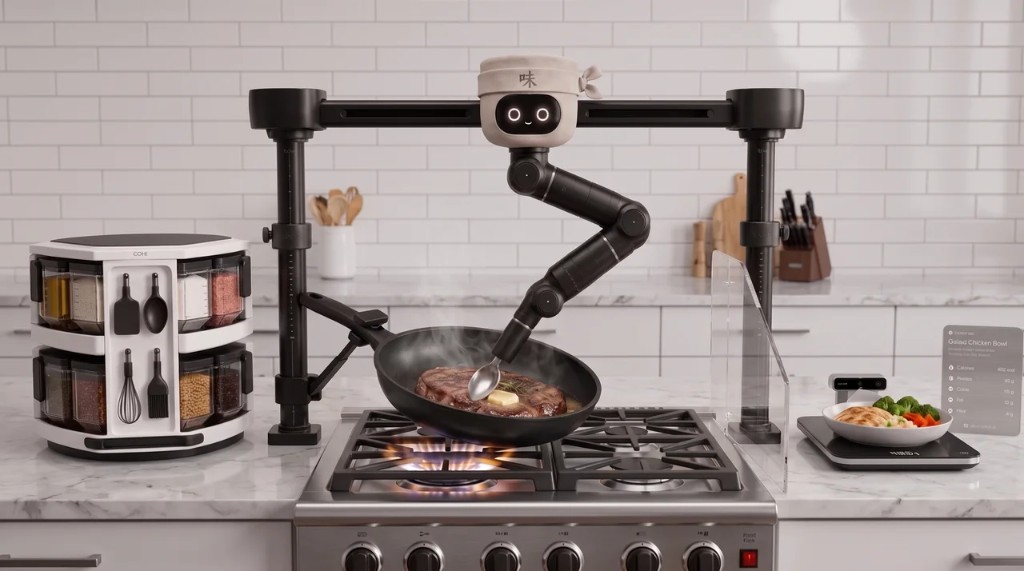
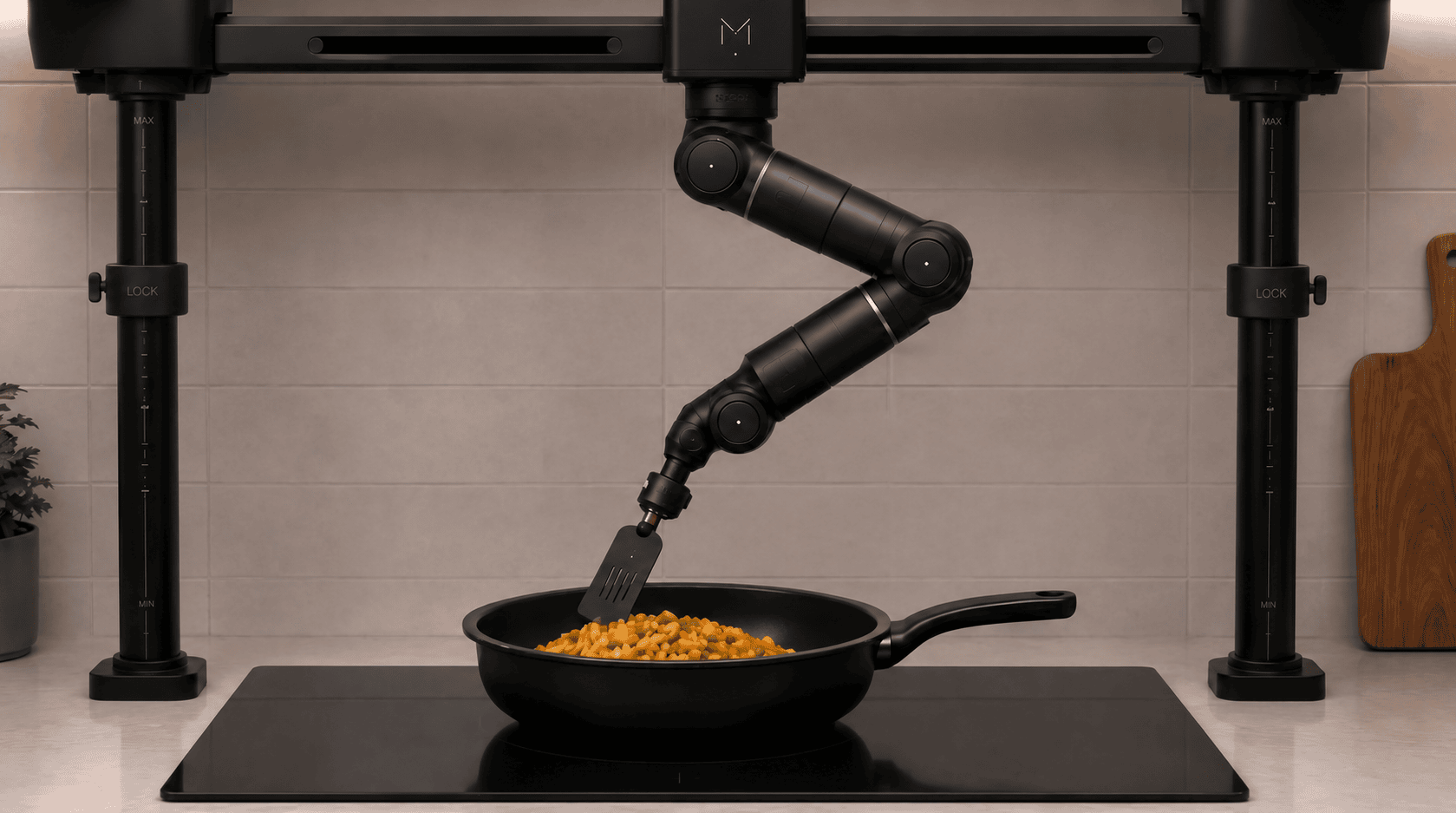
Cheffy closes it by refusing to cook blind. Three cameras watch the pan and read what a cook reads: color, texture, the sheen of a reduction, the browning of a crust. An infrared sensor tracks the pan's real surface temperature continuously, not the number on a dial. For anything thick, Cheffy inserts its own thermometer and reads the inside directly, because the surface of a steak tells you nothing about its center. And through the tools themselves, Cheffy feels, the firmness of a fillet, the resistance of a sauce thickening, the crackle that means a crust has formed. A camera gives Cheffy the visual what. The tools and sensors give it the physical how.
Cooking to a result, not to a clock
Here's the shift. A conventional recipe is a script: do this for this long, then do the next thing. Cheffy's recipes are a set of conditions. "Sear until the crust forms" instead of "sear for four minutes." "Pull the steak at 54°C inside" instead of "flip after six." Time is present, but only as a witness, never the judge. The judge is always the food itself.
This is why Cheffy adapts to a kitchen it has never seen. It doesn't need to know your stove in advance, because it learns your stove's real heating curve the first time it cooks on it, and reads the pan live every time after. It doesn't need a database entry for your specific pan, because it watches what's actually happening inside it. The uncertainty that breaks a fixed recipe is exactly the uncertainty perception was built to handle.
Why this compounds
Every meal Cheffy cooks becomes something it learns from. Not just whether the dish came out right, but what "right" looked like on the way there, the exact color at the moment of doneness, the precise feel of a sauce that had reached the body you wanted. And because a cook's judgment is personal, Cheffy learns yours: rate a plate once as too salty, and the next one adjusts, and the one after that gets closer still. The machine that cooks your dinner tonight is measurably better at cooking your dinner than the one that arrived.
This is the part we're most excited about. A robot that cooks by a fixed script is finished the day it ships, it will make the same mistakes in year three that it made on day one. A robot that cooks by perception is never finished. It gets better with every plate, in every kitchen, and the more it cooks, the more it understands what a good result actually is.
Where we're headed
We're at the beginning of this. Today we're proving the loop on the everyday techniques a home kitchen lives on, searing, sautéing, reducing, simmering, the foundation that most dinners are built from, with hard safety limits underneath every one of them. From there, the horizon is a machine that can look at real ingredients on a real stove and cook them to the exact result a person wanted, without ever being told how long.
Dinner has been run by the clock for a hundred years. We think it's time something finally learned to watch the pan.